What are the Golden Temple timings?
Harmandir Sahib is open for the greater part of every day and, like all gurudwaras, welcomes anyone regardless of faith. The schedule follows the Guru Granth Sahib rather than fixed opening hours: the scripture is installed at prakash in Amrit Vela (roughly the hours between 2 and 6 in the morning) remains seated for about twenty hours, and is carried in the palki to rest at sukhasan late at night. Because prakash and sukhasan shift with sunrise and sunset through the year, summer and winter times differ, so confirm the day's schedule with the shrine before travelling. Your Sevahey Sevak times your seva to that day's actual schedule and confirms the slot in the app.
Is the Golden Temple open 24 hours?
Close to it, but not quite. At Harmandir Sahib the Guru Granth Sahib is installed for about twenty hours of each day and taken to its resting chamber for around four, with the prakash and sukhasan ceremonies marking each end. The complex and its langar keep that long daily rhythm, and gurudwaras in general are open through the hours of the day to anyone who comes.
What are the Golden Temple langar timings?
The langar at Harmandir Sahib serves more than 100,000 free meals every day, running through the day rather than at set sittings, so a devotee arriving at almost any hour can eat. It is free to everyone regardless of religion, caste, gender, or means, the food is lacto-vegetarian, and everyone sits together on the floor in pangat. Through Sevahey, a Karah Prasad & Langar Seva contribution at the Golden Temple is ₹899, offered in your name with video proof returned to you.
What is Harmandir Sahib?
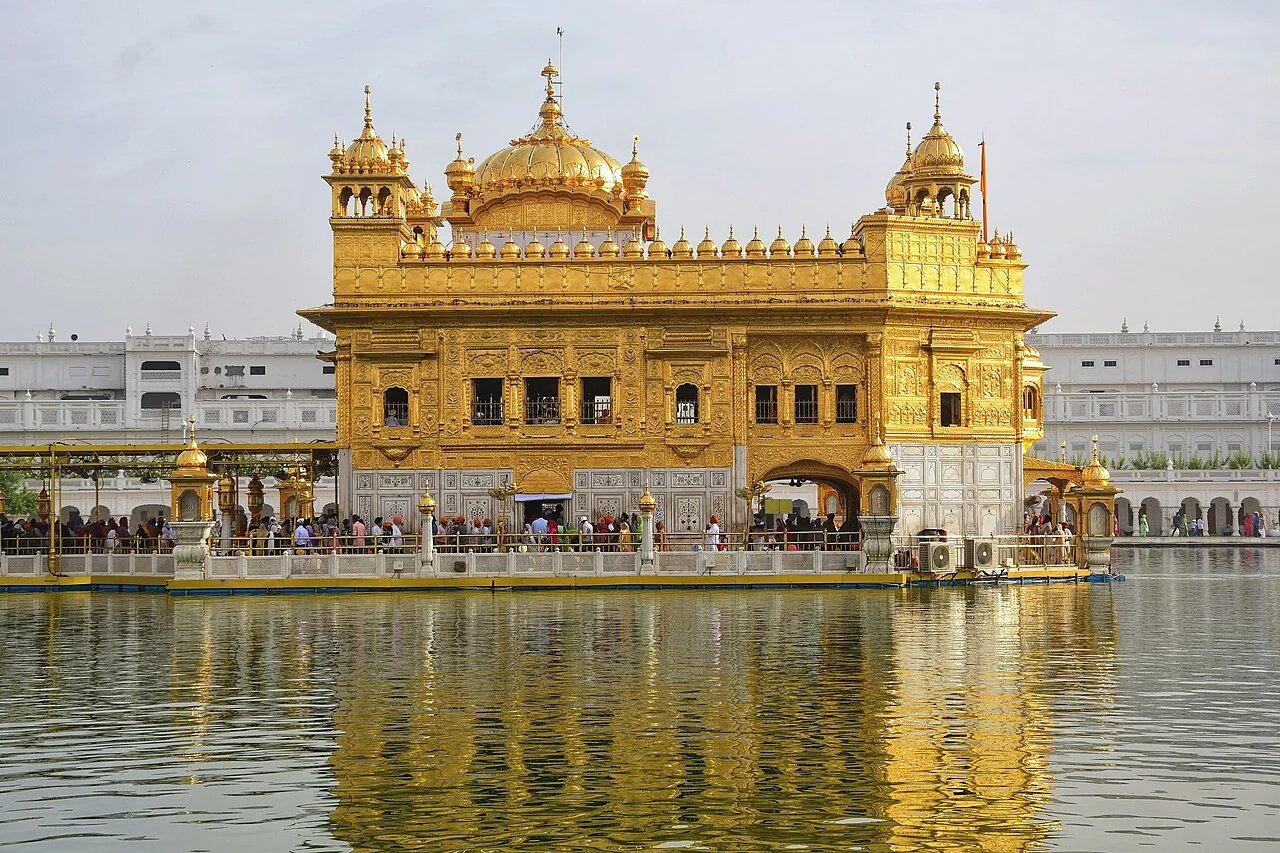
Harmandir Sahib is the formal name of the Golden Temple in Amritsar, the holiest shrine in Sikhism. It stands in the middle of the Amrit Sarovar, the sacred pool that gives Amritsar its name, and was built by Guru Arjan between 1581 and 1589. The English name comes from the gold leaf Maharaja Ranjit Singh laid over the sanctum in 1830.
Who built the Golden Temple?
Guru Amar Das chose the site, and Guru Ram Das completed the sacred pool in 1577, founding the town of Ramdaspur that became Amritsar. Guru Arjan, the fifth Guru, began the shrine in 1581 and completed it in 1589, and installed the Adi Granth inside in 1604. Maharaja Ranjit Singh rebuilt it in marble and copper in 1809 and covered the sanctum in gold leaf in 1830.
Why does the Golden Temple have four doors?
The four entrances of Harmandir Sahib, one on each side, express the Sikh belief in equality, that people of every group, caste, and background are welcome at the shrine, from whichever direction they come. It is the same principle the langar puts on the floor, where everyone sits in one row to eat.
Is the Akal Takht at the Golden Temple one of the five Takhts?
Yes. The Akal Takht stands facing Harmandir Sahib within the same complex in Amritsar, and it is the first and highest of the five Takhts of Sikhism. It was established by the sixth Guru, Guru Hargobind, who wore two swords, miri for temporal authority and piri for spiritual. Harmandir Sahib represents spiritual guidance; the Akal Takht is where justice and the temporal affairs of the Panth are dealt with.
When was the Guru Granth Sahib installed at the Golden Temple?
Guru Arjan installed the Adi Granth inside Harmandir Sahib in 1604 and appointed Baba Buddha as its first granthi. That volume was later completed as the Guru Granth Sahib at Damdama Sahib in Talwandi Sabo, where the hymns of the ninth Guru were added, and Guru Gobind Singh conferred the Guruship on the scripture at Nanded in 1708.
What is kar seva at the Golden Temple?
Kar seva is voluntary, unpaid service offered for a sacred cause, the term joins 'hands' and 'service', and one who performs it is a kar sevak. At the Golden Temple it has meant everything from the periodic cleaning of the Amrit Sarovar to construction in the complex, such as the clock tower gateway built around 1951. Cooking and serving in the langar and washing the parikrama are kar seva too, and anyone may take part.
What is karah prasad?
Karah prasad is the sanctified offering shared at every gurudwara, including the Golden Temple, a halva of whole-wheat flour, ghee, and sugar in equal parts, with double the water. It is prepared by a granthi who has bathed, with Gurbani recited throughout, then stirred with a small sword during ardas and distributed to everyone present in equal portions from the same bowl, received sitting with cupped hands. Through Sevahey, a Karah Prasad & Langar Seva at the Golden Temple is ₹899.
What is the Amrit Sarovar at the Golden Temple?
The Amrit Sarovar is the pool of nectar surrounding Harmandir Sahib, completed by Guru Ram Das in 1577. The city of Amritsar takes its name from it, amrit, nectar, and sarovar, pool. Devotees bathe in it and circle the shrine along the parikrama that runs around its edge.
What is the Nishan Sahib?
The Nishan Sahib is the Sikh flag flown on a tall pole outside a gurudwara, which is how one can be recognised from a distance. It carries the khanda emblem (a double-edged sword between two kirpans, encircled by a chakkar) standing for miri and piri, temporal and spiritual authority. The Sikh Rehat Maryada specifies basanti or surmai for the cloth, and in July 2024 the Akal Takht ruled that kesri is not acceptable. The flag is washed with milk and water and re-robed each year in April at Vaisakhi.
How do I book an online ardas at the Golden Temple?
Open the Sevahey app, choose Harmandir Sahib (Golden Temple) in Amritsar, and select a seva. A verified Sevak then offers your ardas at the Gurudwara and sends you same-day proof. You do not need to travel to Amritsar yourself.
How much does an ardas at the Golden Temple cost?
Every full seva at the Golden Temple is ₹899. There is no subscription, you pay only for the seva you choose.
What proof will I receive after the Golden Temple seva?
After your seva at the Golden Temple you receive GPS-tagged photos from Harmandir Sahib, a short video of the offering, audio from the kirtan or ardas, and a handwritten note from the Sevak, usually the same day.
Who offers the ardas at the Golden Temple?
A verified, named Sevak offers your ardas in person at Harmandir Sahib. Every Sevak is identity-verified by Sevahey, and you see who served you on your proof receipt.
What is a Hukamnama and will I receive one from the Golden Temple?
A Hukamnama is the day's command, a passage read at random from the Guru Granth Sahib and taken as guidance for that day. The Ardas & Hukamnama seva at the Golden Temple is ₹899 through Sevahey, and the day's Hukamnama is shared back to you along with the proof of your ardas.
Can I contribute to the Golden Temple langar from abroad?
Yes. Sangat around the world can contribute to the langar at the Golden Temple through Sevahey and receive proof that the seva was offered in their name, a way to take part in the Guru's free kitchen from anywhere.
What is the Golden Temple known for?
Harmandir Sahib, the Golden Temple, is the holiest shrine in Sikhism, set in the centre of the Amrit Sarovar with doors open on all four sides to welcome people of every faith. Its langar serves over 100,000 free meals a day, and the Akal Takht (the first of the five Takhts) faces it across the complex. With Sevahey, a verified Sevak offers your ardas there and sends same-day proof.
How long does an ardas at the Golden Temple take?
The ardas itself takes a few minutes. Your full proof (GPS-tagged photos, a short video, audio from the kirtan, and a handwritten note) is delivered the same day the seva is done.
Can I book a Golden Temple seva for Vaisakhi or a special date?
Yes. You can request a specific date or occasion such as Vaisakhi or Guru Nanak Jayanti when you book, and your Sevak offers the ardas at the Golden Temple on that day, subject to the Gurudwara's schedule.
Who can I book a Golden Temple ardas for?
You can request an ardas at Harmandir Sahib for yourself, your parents, a child, an ancestor, or anyone in whose name you wish it offered. You provide the name and details when you book.
Is my Sevahey booking private?
Yes. Your booking and the name your ardas is offered in are kept private, only you receive the proof of the seva.
Why book a Golden Temple seva through Sevahey?
Every Sevak is identity-verified, you see exactly who offered your ardas at the Golden Temple, and you receive GPS-tagged photo, video, and audio proof, not just a promise. Every full seva is ₹899, with the price shown upfront and no subscription.
 Place photo · Amritsar